
How to Create Contractor Estimates: Step-by-Step Guide (2026)
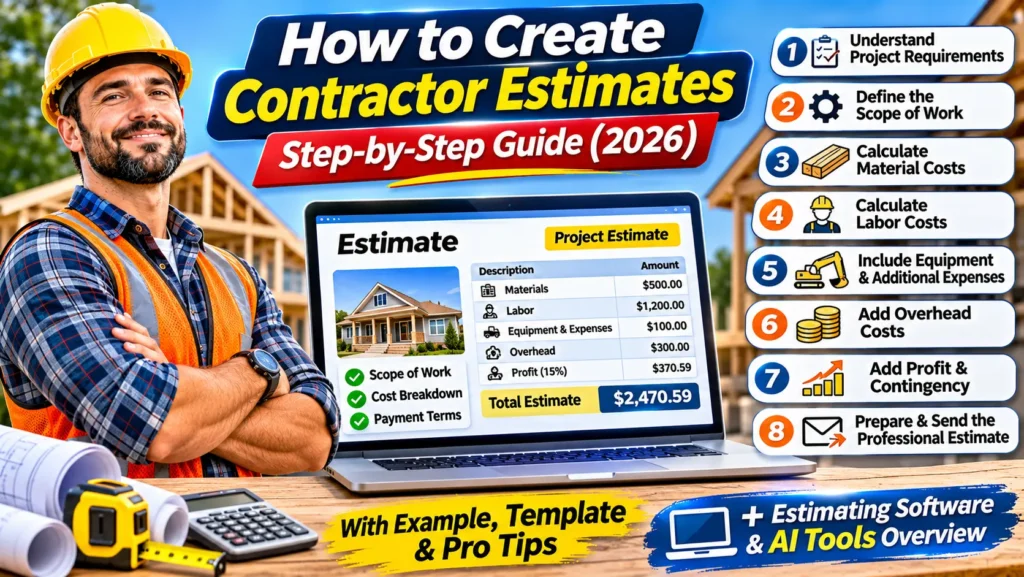
How to Create Contractor Estimates: Creating an accurate contractor estimate is one of the most important parts of running a successful contracting business.
Whether you are a handyman, painter, plumber, electrician, landscaper, or home improvement contractor, customers want to understand how much a project will cost before agreeing to hire you.
A professional estimate helps explain the work, list the materials, calculate labor costs, and show the customer the expected project price.
But there is a problem: many small contractors underestimate their costs. They may forget material waste, labor expenses, equipment rentals, transportation, overhead, or other project-related costs.
As a result, they sometimes accept jobs that generate very little profit.
The good news is that creating a contractor estimate does not have to be complicated.
In this guide, you will learn how to create contractor estimates step by step, calculate labor and material costs, include overhead and profit, and prepare a professional quotation that customers can understand.
We will also explain how contractor estimating software can help organize the process.
What Is a Contractor Estimate?
A contractor estimate is a document that explains the expected cost of completing a specific job or project.
It usually includes the work description, materials, labor, equipment, additional expenses, and estimated total price.
For example, a painting contractor may prepare an estimate for painting the interior of a residential property.
The estimate might include:
- Surface preparation
- Wall and ceiling painting
- Paint and primer
- Labor charges
- Equipment and supplies
- Cleanup
- Estimated completion time
- Total project price
A clear estimate helps the customer understand what is included before the project begins.
It also helps contractors calculate whether the job is financially worthwhile.
How to Create Contractor Estimates: 8 Steps
Follow these eight steps to prepare a professional contractor estimate.
Step 1: Understand the Customer’s Project Requirements
Before calculating any price, understand exactly what the customer wants.
Do not prepare an estimate using incomplete information.
Start by collecting important project details.
Ask the customer:
- What work needs to be completed?
- What is the size of the project?
- Which materials or finishes are required?
- Are there any special customer requirements?
- When should the work begin?
- Is there a preferred completion date?
- Are there existing conditions that could affect the work?
For larger projects, review available drawings, specifications, and project documents.
A site visit is also useful because access, existing damage, site conditions, and other factors can change the amount of work required.
Practical tip: Write down the customer’s requirements before calculating the price. Missing information at the beginning can create expensive mistakes later.
Step 2: Define the Scope of Work
The scope of work describes exactly what your business will do for the customer.
This is one of the most important sections of a contractor estimate.
Instead of writing something vague like:
“Interior painting work – $2,000”
Explain the actual work.
For example:
- Protect floors and furniture.
- Prepare walls and repair minor surface imperfections.
- Apply primer where required.
- Apply two coats of interior paint.
- Complete touch-ups.
- Remove job-related debris and clean the work area.
The customer should understand what is included in the quoted price.
You should also mention exclusions.
For example:
- Major structural repairs are not included.
- Additional rooms are not included.
- Unexpected water damage repairs are excluded.
- Any extra work requires separate approval.
A clearly written scope helps prevent disagreements about what the original estimate covers.
Step 3: Calculate Material Costs
Next, calculate the materials required to complete the project.
Make a material list containing:
- Material description
- Required quantity
- Unit price
- Total material cost
Use current supplier prices rather than relying on old estimates.
For example, a painting project may require:
| Material | Quantity | Unit price | Total |
|---|---|---|---|
| Interior paint | 10 gallons | $35 | $350 |
| Primer | 3 gallons | $25 | $75 |
| Painter’s tape | 5 rolls | $6 | $30 |
| Drop cloths and supplies | 1 lot | $45 | $45 |
| Total | $500 |
The material cost in this example is $500.
However, do not forget delivery fees, material waste, and additional supplies where applicable.
If material prices are likely to change before the project begins, confirm the supplier’s current pricing and include an appropriate estimate validity period.
Step 4: Calculate Labor Costs
Labor is another major part of contractor estimating.
You need to calculate how many workers are required and how many hours the project may take.
Use this basic formula:
Labor Cost = Number of Workers × Hours × Hourly Labor Cost
For example:
- Workers required: 2
- Estimated hours per worker: 20
- Hourly labor cost: $30
Calculation:
2 × 20 × $30 = $1,200
The basic labor cost is $1,200.
However, the actual cost of employing a worker may be higher than the base wage.
Depending on the business and location, labor burden may include:
- Employer payroll taxes
- Workers’ compensation
- Employee benefits
- Paid time off
- Other employment-related expenses
If you are a business owner working on the project yourself, include a reasonable cost for your own labor too.
Do not treat your working hours as free labor simply because you own the business.
Step 5: Include Equipment and Additional Expenses
Some projects require equipment, transportation, subcontractors, permits, or waste disposal.
These expenses should not be forgotten.
Depending on the project, additional costs may include:
- Equipment rentals
- Specialized tools
- Vehicle transportation
- Fuel
- Subcontractor charges
- Permit fees
- Waste removal
- Site cleanup
- Delivery charges
For example, if you need to rent specialized equipment for a renovation project, include the rental cost in your estimate.
If a subcontractor provides part of the work, obtain a current quotation and include the appropriate amount.
The purpose is to account for the actual resources needed to complete the job.
Step 6: Calculate Overhead Costs
Overhead refers to the operating expenses required to run your contracting business.
These costs may not belong to one specific project, but your business still needs to recover them.
Common overhead expenses include:
- Business insurance
- Office expenses
- Accounting fees
- Marketing costs
- Software subscriptions
- Phone and internet
- Vehicle expenses
- Administrative costs
For example, assume your business has $3,000 in monthly overhead and completes 10 jobs per month.
The average overhead allocation would be:
$3,000 ÷ 10 = $300 per job.
This is a simplified example. A better allocation method may use job revenue, labor hours, or another measure that reflects how your business uses its resources.
The important point is that every project should contribute fairly toward the cost of operating your business.
Step 7: Add Profit and Contingency
After calculating direct costs and overhead, determine the profit you want to earn.
Remember:
Revenue is not the same as profit.
If you charge a customer $2,000, that does not mean you earn $2,000.
You still need to pay for labor, materials, equipment, overhead, and other project expenses.
A simplified example:
| Cost category | Amount |
|---|---|
| Materials | $500 |
| Labor | $1,200 |
| Equipment and additional expenses | $100 |
| Overhead allocation | $300 |
| Total estimated cost | $2,100 |
Suppose you want a 15% profit margin on the final selling price.
Use this formula:
Selling Price = Total Cost ÷ (1 − Desired Profit Margin)
Calculation:
$2,100 ÷ (1 − 0.15) = $2,470.59
The estimated selling price would be approximately $2,470.59 before any applicable taxes.
Notice the difference between markup and margin.
Adding 15% to the cost gives a selling price of $2,415, but the actual profit margin would be lower than 15%.
Contingency is another consideration.
For projects with genuine uncertainty, you may include an appropriate allowance for unforeseen costs. The amount should reflect the project’s risks rather than being an arbitrary extra charge.
Step 8: Prepare and Send the Professional Estimate
Once you have calculated the costs, organize everything into a professional document.
A complete contractor estimate should include:
- Your business name and contact information.
- Customer name and contact details.
- Project address.
- Estimate number and date.
- Scope of work.
- Material breakdown.
- Labor charges.
- Equipment and additional costs.
- Overhead and pricing summary.
- Final estimated price.
- Estimated project timeline.
- Payment terms.
- Exclusions and conditions.
- Estimate expiration date.
- Customer approval section.
Before sending the estimate, review the calculations carefully.
Check that the quantities, labor hours, materials, and final price are correct.
A professional estimate should be easy for customers to read and understand.
Contractor Estimate Example: Complete Cost Breakdown
Let’s put the steps together using a simplified residential painting project.
Assume a contractor is preparing an estimate for an interior painting job.
Here is an illustrative cost breakdown:
| Cost category | Estimated amount |
|---|---|
| Materials | $500 |
| Labor | $1,200 |
| Equipment and additional expenses | $100 |
| Overhead allocation | $300 |
| Total estimated cost | $2,100 |
| Target profit margin | 15% |
| Estimated selling price | $2,470.59 |
This example demonstrates how to calculate a selling price using a target profit margin.
Actual project costs will vary based on property size, material selection, labor requirements, local prices, and job conditions.
Applicable taxes should be handled according to the relevant local rules.
Free Contractor Estimate Template: What Should It Include?
A contractor estimate template can help you create consistent quotations for different customers.
You can start with a spreadsheet or document template and customize it for your business.
Here is a basic structure you can use.
Contractor Estimate Template
Business Information
- Business name:
- Business address:
- Phone number:
- Email address:
- Website:
Customer Information
- Customer name:
- Customer address:
- Phone number:
- Email address:
Project Information
- Project name:
- Project location:
- Estimate number:
- Estimate date:
- Valid until:
Scope of Work
Describe the work that will be performed.
Cost Breakdown
| Description | Quantity | Unit Cost | Total |
|---|---|---|---|
| Materials | |||
| Labor | |||
| Equipment | |||
| Subcontractors | |||
| Additional expenses |
Pricing Summary
- Subtotal:
- Overhead:
- Profit:
- Contingency, if applicable:
- Applicable taxes:
- Final estimated price:
Payment Terms
Explain the deposit, payment milestones, and final payment requirements.
Exclusions and Conditions
Mention any work that is not included in the estimate.
Customer Approval
- Customer signature:
- Approval date:
This structure provides a starting point. Customize it to match your trade, local requirements, and business processes.
Common Contractor Estimating Mistakes to Avoid
Even experienced contractors can make estimating mistakes.
Here are some common problems that can reduce your profit.
1. Forgetting Small Material Costs
Tape, fasteners, protective materials, adhesives, and other small supplies may seem inexpensive.
However, these expenses can add up across multiple projects.
Include the materials required to complete the job.
2. Underestimating Labor Hours
A project may look simple during the first inspection.
But preparation, travel, cleanup, and unexpected site conditions can increase the total working time.
Use your previous project records to improve future labor estimates.
3. Ignoring Overhead
Insurance, software, vehicles, marketing, and administrative expenses still need to be paid.
If your estimates only cover materials and worker wages, your business may struggle to generate a sustainable profit.
4. Using Outdated Supplier Prices
Material prices can change.
Confirm current supplier pricing before sending a quotation, particularly for projects that will start several weeks later.
5. Writing Vague Scope Descriptions
A vague estimate can create disagreements.
Clearly explain what is included, what is excluded, and how additional work will be priced.
6. Forgetting Payment Terms
Your estimate should explain when the customer needs to pay.
Depending on the project and applicable rules, this may involve a deposit, progress payments, or a final payment.
7. Sending Estimates Without Reviewing Them
Never assume that a calculation or AI-generated estimate is automatically correct.
Check every quantity, unit price, labor calculation, and final total before sending it.
Manual Estimating vs Contractor Estimating Software
You do not necessarily need paid software to create a contractor estimate.
Many small businesses can begin with spreadsheets or document templates.
However, as the number of customer quotations grows, manually preparing every document can become repetitive.
Here is a general comparison.
| Requirement | Manual templates | Contractor software |
|---|---|---|
| Basic estimate creation | Yes | Yes |
| Custom cost calculations | Manual | Depends on software |
| Reusable templates | Yes | Often available |
| Customer approvals | Separate process | Available on eligible platforms |
| Invoicing | Separate document | Available in many platforms |
| Change-order management | Manual | Available in some platforms |
| Customer tracking | Manual | Available in broader platforms |
| AI-assisted drafting | Usually not included | Available in selected products |
The right choice depends on how many estimates you prepare and which administrative tasks you want to manage digitally.
Can AI Help Contractors Create Estimates?
AI can help organize information and prepare draft estimate content.
For example, some AI-assisted tools allow contractors to describe a job in plain language and generate a starting draft containing a job title, scope of work, exclusions, or suggested line items.
However, AI should not replace professional judgment.
It may not know the exact condition of a property, the correct measurements, the current supplier price, or the specific labor requirements of a job.
A contractor must still verify:
- Measurements and quantities
- Material specifications
- Labor hours
- Supplier prices
- Additional expenses
- Final selling price
AI is most useful as an assistant for drafting and organizing information, not as an automatic guarantee of an accurate or profitable estimate.
How FieldQuote AI Can Help With Contractor Estimates
FieldQuote AI is one platform worth investigating if you want an AI-assisted quoting workflow.
According to its published product information, users can describe a job in plain language and receive a draft containing elements such as the job title, scope of work, exclusions, and suggested line items.
The platform also advertises:
- Professional quote previews
- Customer approval pages
- Typed customer signatures
- Change-order workflows
- Invoicing
- A mobile-first approach
The published subscription price is $19.99 per month through ClickBank.
This is a recurring subscription, not a one-time purchase.
FieldQuote AI may be worth evaluating if you regularly prepare customer quotations and want a more organized drafting and approval process.
However, you should still check the generated information, quantities, and prices before sending an estimate to a customer.
Explore FieldQuote AI
Want to explore an AI-assisted quoting workflow for your contracting business?
You can review the platform’s advertised features and current subscription terms here.
Explore FieldQuote AI – View Features and Pricing
Affiliate Disclosure: This article contains an affiliate link. We may earn a commission if you purchase through this link, at no additional cost to you.
Frequently Asked Questions
How do you create a contractor estimate?
Start by understanding the project requirements and defining the scope of work. Calculate materials, labor, equipment, and additional expenses. Add overhead, profit, and any appropriate contingency. Then prepare a professional estimate with payment terms and exclusions.
What should a contractor estimate include?
A contractor estimate should include business and customer details, project information, scope of work, materials, labor, additional costs, total price, timeline, payment terms, exclusions, and approval details.
How do contractors calculate labor costs?
A basic labor calculation is the number of workers multiplied by their estimated working hours and hourly labor cost. Contractors should also account for applicable payroll taxes, insurance, benefits, and other labor-related expenses.
Should contractors include overhead in estimates?
Yes. Contractors should account for operating expenses such as insurance, vehicles, office costs, software subscriptions, marketing, and administrative expenses.
What is the difference between markup and profit margin?
Markup is calculated as a percentage added to cost. Profit margin is calculated as a percentage of the final selling price. They are different calculations and should not be confused.
Can I create contractor estimates using Excel?
Yes. A spreadsheet can be used to list materials, labor hours, unit costs, overhead, and profit. It is a practical starting option for small contractors with straightforward estimating requirements.
Is contractor estimating software worth it?
It may be useful if you regularly prepare estimates, manage customer approvals, send invoices, or handle multiple projects. Contractors with simple requirements may be able to use free spreadsheets and templates.
Can AI create accurate construction estimates?
AI can help draft estimate content and organize job information. However, contractors must verify measurements, quantities, labor, supplier pricing, and other project costs before sending a final estimate.
Conclusion: Create Accurate Estimates and Protect Your Profit
Creating a professional contractor estimate is about more than giving a customer a price.
You need to understand the project, calculate the required materials, estimate labor, include additional expenses, recover overhead, and account for profit.
A clear scope of work and transparent cost breakdown also help customers understand what they are paying for.
Start with a consistent estimating process. Use a spreadsheet or contractor estimate template if that is enough for your business. Consider dedicated software when managing estimates, approvals, and invoices becomes too time-consuming.
Most importantly, never send an estimate without reviewing the calculations.
An accurate estimate protects your business, improves communication with customers, and gives every project a clearer financial starting point.
Editorial Disclaimer
The examples in this guide are illustrative and are not universal labor rates, profit recommendations, or construction prices. Actual costs depend on project conditions, local supplier pricing, labor requirements, taxes, and applicable regulations. Always verify project details before issuing a customer quotation.